20 Portfolio Website Examples to Inspire You in 2026
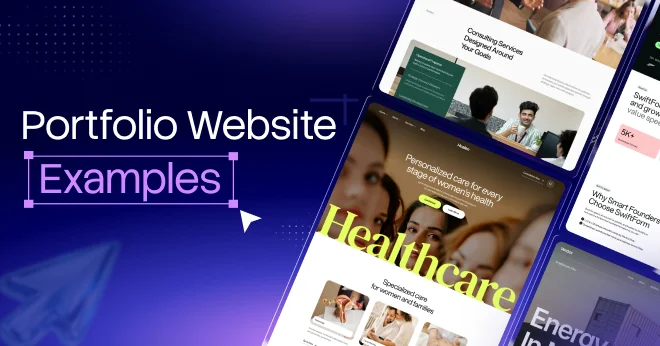
A portfolio website is often your first impression on potential clients, recruiters, or collaborators. Within seconds of visiting, they’re judging your work, skills, and whether you're the right fit.
In this guide, we’ve selected 20 portfolio website examples from designers, developers, photographers, artists, writers, and creative studios.
For each example, we explain what makes the website effective, which platform it uses, and one idea you can apply to your own portfolio.
How we selected these examples
We reviewed 20 live portfolio websites in 2026 and assessed their visual design, content clarity, and practical value. The list covers different professions and design styles, with useful ideas you can apply to your own portfolio.
Portfolio Website Examples at a Glance
This table lists all 20 examples, the platform behind every site, and the one thing worth borrowing.
Designer Portfolio Examples
Designers have the hardest job here: your portfolio is proof of your skill. These five turn their own sites into their best project.
1. Simon Holm Larsen
Built with: Webflow
Best for: Brand designers
Standout feature: Typography-first layout
Simon Holm Larsen is a digital-first brand designer whose website won Awwwards Site of the Day on May 9, 2026. Large, confident typography and short video previews of six featured projects give the site the feel of an editorial magazine rather than a traditional portfolio.
For a brand designer, this bold and consistent visual style serves as a direct example of their design skills.
Steal this idea: Make your portfolio reflect your design style. If you create bold brand identities, use the same approach on your own website.
2. Cherry Phan
Built with: Webflow
Best for: UI/UX and product designers
Standout feature: Gallery-like presentation
Cherry Phan is a UI/UX and digital product designer whose portfolio feels more like a curated gallery than a resume. The same visual style carries from the homepage to every project page, so visitors can quickly recognize her design approach.
Steal this idea: Present all your projects with a consistent visual style. A shared look makes your portfolio feel like a carefully selected collection rather than a random mix of work.
3. Joseph Berry
Built with: Webflow
Best for: Interaction and experience designers
Standout feature: Immersive motion
Joseph Berry is a London-based experience designer, an Awwwards jury member, and a recognized name in the Webflow community. His site uses video, animation, and interactive elements to create an immersive experience, while the minimal layout keeps the focus on his work.
The motion serves a clear purpose: it demonstrates the same skills he offers to clients.
Steal this idea: If interaction design is one of your services, let visitors experience your skills through your website instead of just reading about them.
4. Lynn Fisher
Built with: Custom code
Best for: Web designers and front-end developers
Standout feature: A fresh redesign every year
Lynn Fisher is a Phoenix-based web designer, CSS developer, and artist who redesigns her portfolio every year. Her website is now on version XIX, with every new version introducing fresh ideas and design techniques.
Steal this idea: Treat your portfolio as an ongoing project. Update it every year to keep your work current and test new design ideas.
5. Bryn Taylor
Built with: Custom build (Sanity CMS)
Best for: Freelance product and website designers
Standout feature: Proof stacked on one page
Bryn Taylor is a Copenhagen-based freelance product and website designer with over 12 years of experience. His homepage features client logos from brands like Monzo, Pleo, and Mastercard, along with focused case studies, side projects, and a large collection of client testimonials.
By the time visitors reach the contact section, they have already seen clear proof of his experience and work quality.
Steal this idea: Use multiple forms of proof. Client logos, concise case studies, and genuine testimonials work together to build trust and support your credibility.
Developer Portfolio Examples
For developers, a portfolio is also a sample of their code. These four examples range from a fully interactive 3D game to a simple, well-designed one-page site.
6. Bruno Simon
Built with: Three.js
Best for: Creative developers
Standout feature: A drivable 3D world
Bruno Simon's original car-driving portfolio won Awwwards Developer Site of the Year in 2019. The rebuilt version keeps the same concept: visitors drive a small car through a 3D world to explore his work. It also adds achievements, a race circuit, and short messages from other visitors.
The site uses Three.js with WebGL and WebGPU support, along with the Rapier physics engine. Bruno also shares the full source code on GitHub.
Steal this idea: You don't need to build a 3D game for your portfolio. Choose one interactive feature that reflects your personality and skills, then make it the main attraction of your site.
7. Brittany Chiang
Built with: Next.js and Tailwind CSS
Best for: Front-end engineers and job seekers
Standout feature: One-page resume layout
Brittany Chiang is a Senior Frontend Engineer at Klaviyo, and her portfolio is one of the most referenced developer websites online. The dark, single-page layout uses sticky navigation to help recruiters jump between the About, Experience, and Projects sections without leaving the page.
Her previous Gatsby version earned more than 6,000 stars and 3,000 forks on GitHub.
Steal this idea: Combine your resume and portfolio on one page. This helps recruiters review your experience and projects without visiting multiple pages.
8. Keita Yamada
Built with: Custom code (three.js, GSAP)
Best for: Designer-developers
Standout feature: Switchable display modes
Keita Yamada is an Osaka-based designer and developer whose website keeps things simple while reflecting his personality. Visitors can switch between light, dark, and monospaced modes. A subtle Three.js background effect adds depth without distracting from the content.
His projects appear in a clean timeline with dates and roles. He also has a FAQ page that answers common questions, including how he built the background effect.
Steal this idea: Keep your portfolio structure simple and add one or two personal touches, such as a display mode toggle, to make it memorable.
9. Adham Dannaway
Built with: WordPress
Best for: Hybrid designer-developers
Standout feature: Split introduction
Adham Dannaway is a product designer and front-end developer. His homepage explains both roles through one split image, with one half representing design and the other coding. Visitors understand his skill set at a glance, even before they read the text.
The rest of the site supports this message with design system projects, a UI design book, and lessons on UI design.
Steal this idea: If you offer two different skills, use one clear visual on your homepage to represent both.
Photography and Video Portfolio Examples
When your work is visual, your website should keep the focus on it. These two examples let the photos and videos speak for themselves.
10. Levon Biss
Built with: Squarespace
Best for: Photographers
Standout feature: Large, detailed imagery
Levon Biss is a British photographer best known for Microsculpture, a project that captures insects at extraordinary magnification. His homepage features a grid of large images, with every image leading to a photo series. These include Microsculpture, Seeds & Fruits, Extinct & Endangered, and his Amber series.
Visitors can also access his books, exhibitions, videos, and online shop with one click. This makes the site both a photo gallery and a business platform.
Steal this idea: Organize your photos into clear series. This lets visitors explore your work like an exhibition instead of scrolling through one long feed.
11. Danny Cooke
Built with: WordPress
Best for: Filmmakers and videographers
Standout feature: Showreel-first homepage
Danny Cooke is a UK-based filmmaker, director, and cinematographer whose short film Postcards from Pripyat, Chernobyl has received millions of views.
His homepage starts with a brief introduction to his work and a showreel, followed by a grid of projects with short video previews.
His website also brings in business. In an interview with WPZOOM, he said, "Most of my commercial work comes through my website and portfolio."
Steal this idea: If your work involves video, feature it on your homepage. A short showreel gives visitors a clear sense of your style and skills.
Artist and Illustrator Portfolio Examples
Artists sell a style as much as a skill. These three make their personality impossible to miss, and two of them turn their portfolio into a small business.
12. Alice Lee
Built with: Webflow
Best for: Illustrators and muralists
Standout feature: A clear intro that doubles as navigation
Alice Lee is a San Francisco-based artist who introduces herself with one playful line: illustrator, muralist, ceramicist, content creator, and maker of delightful things. Each role links to its own section, so her introduction also works as a navigation menu.
Below it, a detailed project list identifies every piece by type and client, with names like Adobe, Google, Uniqlo, and The Washington Post.
Steal this idea: Turn your introduction into navigation. If you offer several types of creative work, link each role to its relevant projects.
13. Lauren Hom
Built with: Squarespace
Best for: Lettering artists and creative educators
Standout feature: Portfolio, classes, and shop in one site
Lauren Hom is a designer and lettering artist who specializes in lettering, murals, and food art. Her homepage puts client projects first, followed by links to her online courses, store, blog, and a list of her favorite tools.
Her portfolio also supports several income sources beyond client work, including courses and product sales.
Steal this idea: If you teach or sell products, feature them on your portfolio. Visitors who like your work can also become students or customers.
14. Beeple
Built with: Custom build
Best for: Digital artists with an ongoing series
Standout feature: A live counter of consecutive days
Beeple, the digital artist Mike Winkelmann, has published a new artwork every day since May 1, 2007, in a series called Everydays. In 2021, a collage of his first 5,000 pieces sold at Christie's for $69 million.
His website displays a live count of his consecutive daily artworks, now past 7,000. It also features a humorous bio, free VJ loops, and his films.
Steal this idea: If you have a creative habit or ongoing project, make it visible on your website. A record of your progress gives visitors a reason to return.
Writer and Marketer Portfolio Example
Writers, marketers, and consultants sell their thinking. A clear message and easy next steps matter more here than big visuals.
15. Aja Frost
Built with: Custom build
Best for: Marketers, writers, and consultants
Standout feature: Expertise-led homepage
Aja Frost is a growth marketing leader with nearly a decade of experience at HubSpot, where she has worked on SEO, AEO, content, and growth. Her homepage sums up her experience in a short bio, followed by her main areas of expertise, including Answer Engine Optimization and B2B growth strategy.
The navigation keeps things simple with links to Speaking, Consulting, her Platonic Love media brand, and Contact. Visitors can quickly understand her expertise and find ways to work with her.
Steal this idea: If your work centers on writing or strategy, lead with your expertise. Give visitors direct access to your services and contact details.
Studio and Agency Portfolio Examples
Clients choose creative studios for their design style as much as their services. So, a studio website needs to show a clear creative direction. Three of these four examples use Webflow.
16. &Walsh
Built with: Custom build
Best for: Creative agencies
Standout feature: A naming system tied to the brand
&Walsh is a New York creative agency founded by designer Jessica Walsh in 2019, after she departed from Sagmeister & Walsh. The agency carries its brand identity into the project list, where every title starts with an ampersand, such as &Google I/O 2023 and &Bombas.
This small detail turns a simple project list into another part of the agency's visual identity.
Steal this idea: Choose one small, repeatable detail that reflects your brand and use it throughout your website.
17. Aarland
Built with: Webflow
Best for: Web design studios
Standout feature: GSAP scroll animations
Aarland is a design studio based in Aarhus, Denmark. Founded in 2018, it is now a Webflow Certified Partner. Its website uses Webflow's GSAP-powered interactions for scroll animations, a loading animation, and custom CMS grids to present its projects.
The site also serves as a sales tool because it demonstrates the same interactive design skills the studio offers to clients.
Steal this idea: If you build interactive websites for clients, use your own site to demonstrate what you can do.
18. Jomor Design
Built with: Webflow
Best for: Small studios and solo practices
Standout feature: Playful copy with a premium look
Jomor Design is an independent design studio that specializes in branding and website design. Its website is one of the most-liked portfolios in Webflow's Made in Webflow showcase.
A collage of project images, a showreel, and four featured projects create a polished first impression. The copy also keeps things friendly and approachable. Its tagline promises "great design services" without sounding pretentious.
Steal this idea: Combine polished visuals with a warm, honest tone. Clients connect with studios that sound approachable and genuine.
19. Heco Partners
Built with: Webflow
Best for: UX and branding studios
Standout feature: Playful transitions and project views
Heco Partners is a Chicago-based design studio founded by JT Helms and Matt Cowen. The studio focuses on user experiences and brand design. Its playful page transitions and project layouts helped make it one of the most-liked studio websites on Made in Webflow.
The studio's bio even mentions its search for inner peace. This small detail adds personality and gives visitors a glimpse of the people behind the work.
Steal this idea: Add a touch of humor to your studio bio. One unexpected detail can make your studio more memorable than a simple list of services.
Beginner-Friendly Portfolio Example
New to portfolio building? This example shows that a simple, honest presentation of your work can be enough to make a good impression.
20. Gloria Lo
Built with: Webflow
Best for: New and self-taught designers
Standout feature: Three focused case studies
Gloria Lo taught herself product design without a bootcamp or design degree. She is now a Principal Product Designer at Canva, but her portfolio remains simple: three case studies, an About page, and a Play section for her music and art.
Her introduction sums up her work in one line: "I design, sing, paint & write." Each word links to a related section, so visitors can quickly explore her skills and interests.
Steal this idea: Start with three well-explained projects and let your personal interests show. A small portfolio with personality can leave a better impression than a large collection of generic work.
What Every Great Portfolio Has in Common
These 20 portfolios look very different, but the ones that attract clients share six key features:
- A clear introduction: Explain who you are and what you do in one specific line. For example, use "Brand designer based in Copenhagen" instead of a vague label like "creative problem solver."
- Curated work: Display 6 to 10 of your best projects. Choose work that reflects the type of projects you want from future clients.
- Short case studies: Cover the project challenge, your role, your approach, and the results. This helps clients understand how you think and solve problems.
- Personality: Add one unique feature that reflects your style, like Bruno Simon's 3D world or Beeple's daily artwork counter.
- Fast, mobile-friendly pages: Compress images and test your website on a real phone before sharing it.
- Easy contact: Place your email address or a "Work with me" button where visitors can find it within seconds.
4 Portfolio Design Trends We Noticed in 2026
Looking at all 20 portfolios side by side, a few bigger patterns stand out.
1. Website Builders Power Most Portfolios
Twelve of the 20 sites use a website builder or CMS rather than custom-coded websites. Eight run on Webflow, two on Squarespace, and two on WordPress. Simon Holm Larsen's Awwwards Site of the Day also proves that you can produce award-winning work without writing every line of code.
2. Portfolios Are Becoming Small Businesses
More creatives now sell products and services directly through their portfolios. Lauren Hom offers online classes and a store, Bryn Taylor sells website templates, and Levon Biss features books, prints, and exhibitions. Your portfolio can generate income even between client projects.
3. Video Previews Are Replacing Static Thumbnails
Short video previews give visitors a better sense of a project before they open it. Simon Holm Larsen, Danny Cooke, and Jomor Design use motion to preview their work instead of relying only on static images.
4. Portfolios Are Helping Creatives Build an Audience
Some portfolios give visitors a reason to return. Alice Lee shares an illustrated email zine, Aja Frost co-runs a newsletter brand, and Bryn Taylor collects email subscribers right on his homepage. A simple sign-up form can turn a one-time visit into an ongoing connection.
How to Build Your Portfolio Website
Ready to build your own portfolio? Follow these six steps to get started.
- Choose your platform: Webflow gives you design control, hosting, and a CMS without code. New to the platform? Start with What Is Webflow? or compare Webflow vs. WordPress and Framer vs. Webflow.
- Select 6 to 10 projects: Choose work that matches the projects you want to attract. Write a short case study for every project that covers the challenge, your role, your approach, and the result.
- Start with a template: A professional portfolio template gives you a polished, responsive layout from the start.
- Connect a custom domain: A domain like yourname.com gives your portfolio a professional address that you can keep if you switch platforms later.
- Help people find your portfolio on Google: Include your name, role, and location in page titles. Give every project its own page, add descriptive alt text to images, and submit your sitemap through Google Search Console.
- Launch and update your portfolio: Share your website link on your social profiles and professional platforms. Add new projects as your work grows.
Final Thoughts
The best portfolio websites come in every style. Bruno Simon built a game, Brittany Chiang kept it to one clean page, and Gloria Lo started with just three case studies. What they share is clarity, personality, and a focus on the work that matters most.
Use these examples as a starting point, not a blueprint. Borrow the ideas that fit your work, then make the site unmistakably yours.
Ready to build your portfolio? Explore Flownix Webflow templates and launch with a professional layout from day one.
FAQ
At a minimum, include a clear introduction, your best projects, short case studies that explain your role, an about section, and an easy way to contact you. Testimonials and client logos are helpful extras.
Most people do best with 6 to 10 strong projects. If you are just starting out, three well-explained projects, including personal or practice work, are enough to get started.
Yes, with a few limits. Webflow's free Starter plan lets you publish a site with up to 2 static pages on a webflow.io address. For your own domain and more pages, you'll need a paid plan, starting with Basic at $15 a month billed yearly.
You can start without one, but a custom domain like yourname.com looks more professional and is easier to remember. It also stays yours if you ever switch platforms.
If you're job hunting, yes. Add a downloadable PDF or an experience section like Brittany Chiang's. If you freelance, testimonials and a clear list of services will win you more work than a resume.
Add your name, role, and location to your page titles, give every project its own page, and describe your images with alt text. Then submit your sitemap in Google Search Console. Rankings build over time, so keep adding fresh projects.